Odyssey image

THEMIS scientists are tracking a dust storm that erupted on Mars in March 2009.

Scientists at Arizona State University's Mars Space Flight Facility are using the Thermal Emission Imaging System (THEMIS) on NASA's Mars Odyssey orbiter to monitor a new dust storm that has erupted on the Red Planet.

The dust storm began in mid-March 2009, in the large, Southern Hemisphere impact basin Hellas. It has since grown as it spread northward in a patchy fashion. How large the storm will become is unknown.

"This storm is coming at a time in the Martian year -- near the planet's closest approach to the Sun -- when dust storms are common," says Philip Christensen, of ASU's Mars Space Flight Facility. Christensen is the designer and principal investigator for the THEMIS camera. "But so far, this storm has not reached the severity of the big dust storm of 2001, or even the more modest one in 2007."

Dust storms affect operations for all five spacecraft working at Mars. The fleet includes two NASA rovers on the ground (Spirit and Opprtunity), plus three orbiters, two of which belong to NASA (Mars Odyssey and Mars Reconnaissance Orbiter) and one from the European Space Agency (Mars Express).

"If the dust causes a lot of obscuration, we lose the ability to image the ground," explains Christensen. "In big dust storms, the rover teams are strongly affected as dust in the air reduces sunlight which provides power for driving and science operations. And when the dust finally settles out, it coats the solar panels, diminishing their capability."

"We've noticed increasing opacity over the last several days," says Steve Ruff, of the Mars Space Flight Facility. "This has produced roughly a 20 percent drop in power for Spirit." Ruff is in charge of day-to-day operations for the Miniature Thermal Emission Spectrometers, a mineral-scouting instrument each rover carries. "When dust kicks up," he says, "it hurts."

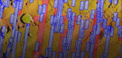
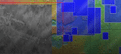
THEMIS scientists are monitoring the dust in the Martian atmsophere using an algorithm which estimates the dust opacity at an infrared wavelength of 9 micrometers. The scale bar in the maps at right extends from nearly clear (0.05) to completely opaque (1.0). These maps are updated weekly, and there's a link to the full archive below the bottom map.

Click on the images for larger versions and to see the data coverage maps. (Image credit: NASA/JPL/Arizona State University)

Last Updated: Fri, 20 Nov 2009 22:59:22 GMT
THEMIS 9 Micron Opacity
Full archive with older images